Search is no longer just a way to find pages. Increasingly, it is becoming a system for finding information, assembling evidence, comparing sources and generating an answer from multiple sources.
That distinction matters.
For most of the history of SEO, the underlying model was relatively easy to understand:
User searches → search engine retrieves documents → documents are ranked → user visits a page
Plenty of complexity lay beneath that process, but the basic relationship between query, ranking, and page was visible enough for marketers to work with.
Generative AI changed all that by adding several new layers.
A simplified model now looks more like:
User prompt → interpretation → query expansion or decomposition → information retrieval → evidence selection → answer generation
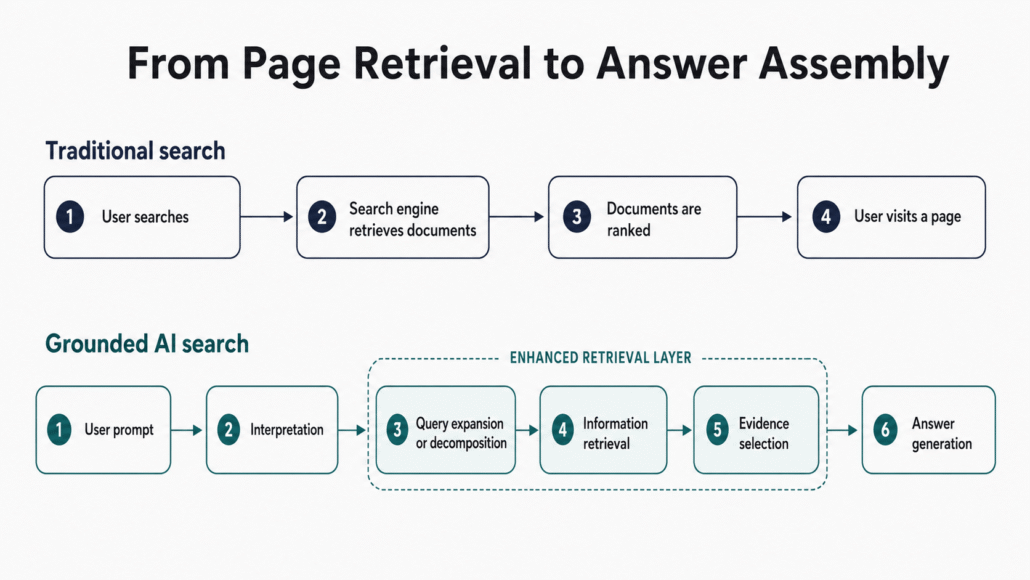
That middle section deserves much more attention than it currently receives.
When someone asks an AI system a question, the system may not simply look for documents containing words that match what the searcher entered (prompted). It may reformulate the request, identify different information needs within it, search for those needs separately, retrieve passages from multiple sources and then pass the resulting material into a language model.
The answer the user sees may therefore be the product of several retrieval decisions that are largely invisible from the outside.
Google has publicly documented one example of this behaviour through what it calls query fan-out (What is Query Fan-Out?). In AI Overviews and AI Mode, Google can issue multiple related searches across topics and data sources before constructing a response.
That raises an important question for anyone working in SEO or Generative Engine Optimisation (GEO):
Should we be optimising only for the words a user enters, or for the wider information-retrieval process an AI system may use to answer them?
Once you begin thinking in those terms, several topics that can initially seem highly technical – grounding, Retrieval-Augmented Generation, semantic retrieval, embeddings, entities and information ingestion – become directly relevant to GEO strategy.
They are not abstract machine-learning concepts sitting somewhere outside search marketing.
They increasingly describe the machinery sitting between a question and an answer.
What Is Grounding?
Large language models are remarkably good at producing convincing language. That does not mean they are equally good at surfacing verified, current or precise information from their internal knowledge alone.
A language model generates text using patterns learned during training. Inevitably, that internal representation of the world has limitations. It may be incomplete. It may be outdated. It may lack sufficient detail for a specialised question. In some situations, it may simply contain the wrong information.
Grounding is one way AI systems attempt to deal with that problem.
Google describes grounding as ‘connecting generative AI responses to verifiable sources’. Retrieval-Augmented Generation, or RAG, is one of the main techniques used to make that possible.
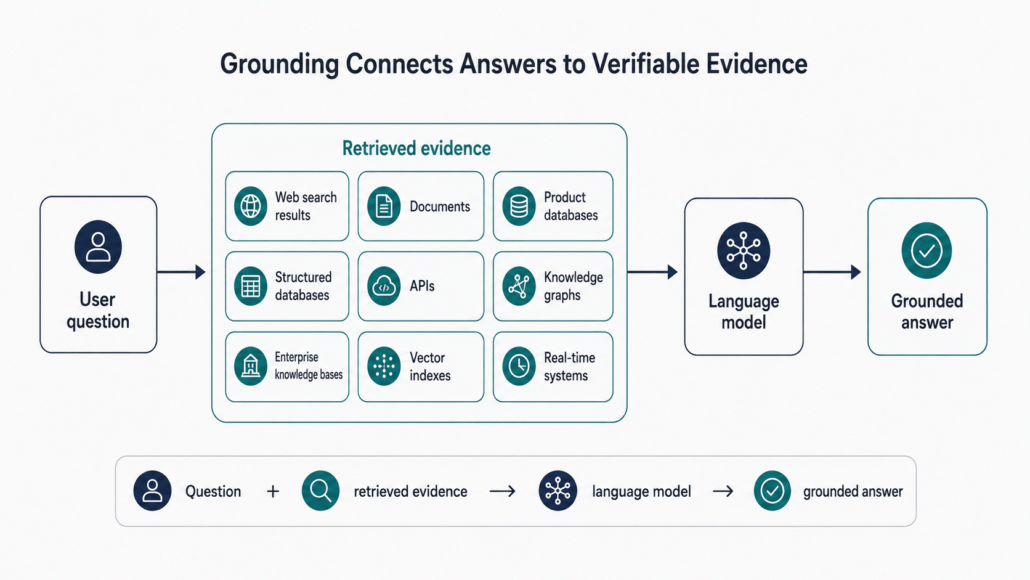
Those external sources can take many forms. They might include web search results (SERPs), documents, product databases, structured databases, APIs, knowledge graphs, enterprise knowledge bases, vector indexes or real-time information systems.
The important point is that the model does not have to answer only from what it learned during training. The system can first retrieve additional material and provide that material to the model as context. In simple terms:
Question + retrieved evidence → language model → grounded answer
That is a fundamentally different process from asking a model to generate an answer using only its pretrained knowledge.
The moment retrieval enters the process, many concepts familiar from information retrieval and search become relevant again. Relevance, indexing, document structure, entities, semantic similarity, authority, freshness and technical accessibility all start to matter.
For GEO practitioners, this is one of the most useful places to begin.
Before asking how to persuade an AI system to mention a brand, we should first understand how that system obtains the information from which its answer is constructed.
What Is a Grounding Query?
The terminology around grounding is not always consistent. Different AI platforms use different architectures, and the exact mechanics are not normally exposed to marketers.
For practical SEO purposes, however, we can think of a grounding query as:
A query an AI retrieval system generates or uses to obtain information needed to answer the user’s original request.
Imagine someone asks ChatGPT: “What should I look for when buying a laptop for video editing?”
A traditional search engine like Google will most likely retrieve pages containing or closely matching that phrase. An AI retrieval system has another option. It can treat the question as a collection of smaller information requirements.
It might need to investigate:
- recommended RAM for video editing
- CPU requirements for 4K editing
- GPU requirements for video workflows
- SSD performance
- laptop display colour accuracy
- battery performance on high-powered machines
- thermal performance
- perhaps even software-specific hardware requirements
The user asked one question, but answering it well may require evidence from several areas (sources).
That is the important distinction.
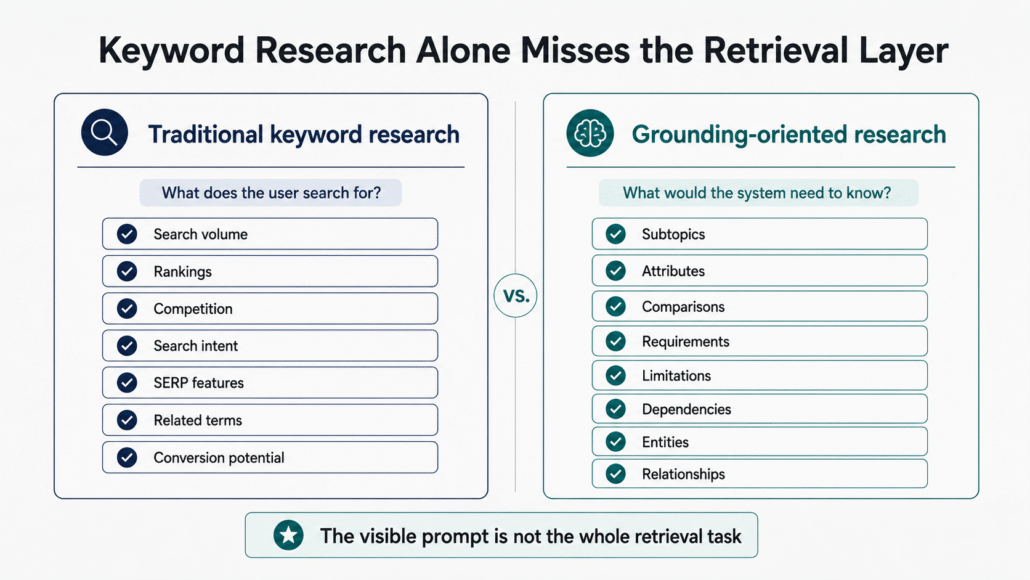
The visible prompt is not necessarily the retrieval task. The prompt may simply be the starting point from which the system works out what information it needs.
Google’s documented use of query fan-out gives us a real-world example of this principle. Its generative search systems can produce several concurrent related queries so that additional information can be collected before an answer is generated.
From a GEO/SEO perspective, this considerably expands the search space.
The queries marketers can see may represent only the first step.
From Keywords to Information Needs
Traditional keyword research begins with observable search behaviour. We identify queries such as best running shoes for beginners. Then we analyse familiar variables:
- search volume
- rankings
- competition
- search intent
- SERP features
- related terms
- conversion potential
That approach remains useful. But conversational AI exposes a limitation in the keyword-only model.
Suppose someone asks, “I’ve just started running three times a week, and my knees sometimes hurt. What type of trainers should I consider?”
That is not really a keyword. It is a description of a situation.
To answer it properly, the system may need to understand beginner running shoes, running surfaces, cushioning, stability, gait, shoe fit, training frequency, knee discomfort and the difference between neutral and stability shoes.
The user has expressed a problem in ordinary language. The retrieval system has to translate that problem into information needs. This translation layer is one of the areas GEO needs to pay much more attention to.
Traditional keyword research asks:
What does the user search for?
A grounding-oriented approach asks another question:
What would a system need to know in order to answer the user properly?
Those are related questions, but they are not identical.
Query Decomposition: Turning Complex Questions Into Searchable Problems
One way a retrieval system can deal with a complicated request is through query decomposition.
Rather than treating a long question as one indivisible search, the system breaks it into smaller queries that can be investigated separately.
Microsoft describes a similar approach in modern agentic retrieval systems within Azure AI Search, where an LLM can turn a complex request into focused subqueries that are then executed in parallel.
Consider “Which type of home heating system is cheapest to run, environmentally friendly and suitable for an older house?”
There are several different dimensions hiding inside that sentence.
At minimum, the system has to think about:
- running cost
- environmental impact
- suitability for older properties
A retrieval process might therefore explore questions such as:
- air-source heat pump running costs
- gas boiler versus heat pump emissions
- heat pumps in poorly insulated homes
- heat pump installation requirements for older houses
- heating-system efficiency comparisons
The final answer can then draw on evidence retrieved across those separate searches. That has an important consequence for content strategy.
A page does not necessarily need to match the user’s complete original question in order to influence the final answer.
A detailed and authoritative page about heat-pump performance in poorly insulated homes could be useful for one part of the response, even if that page never targets the entire long-form query. This is why GEO should not be reduced to an exercise in inventing ever-longer keywords. If AI systems decompose questions into smaller information needs, the opportunity is not simply to create a page matching every imaginable prompt.
The opportunity is to become a strong source for the information required to answer those prompts.
Query Fan-Out and the Expanding Search Space
Query decomposition and query fan-out are closely connected ideas. The original prompt is one point in a much larger semantic space.
From there, a retrieval system can potentially move into:
- synonyms
- related entities
- attributes
- comparisons
- prerequisites
- definitions
- supporting evidence
- adjacent topics
- follow-up questions
You can think of this as a retrieval tree.
Take a query such as “What is the best electric car for long journeys?”
That apparently simple question may lead the system towards information about:
- motorway range
- charging speed
- charging-network compatibility
- battery capacity
- real-world efficiency
- luggage capacity
- cabin comfort
- charging curves
- winter range
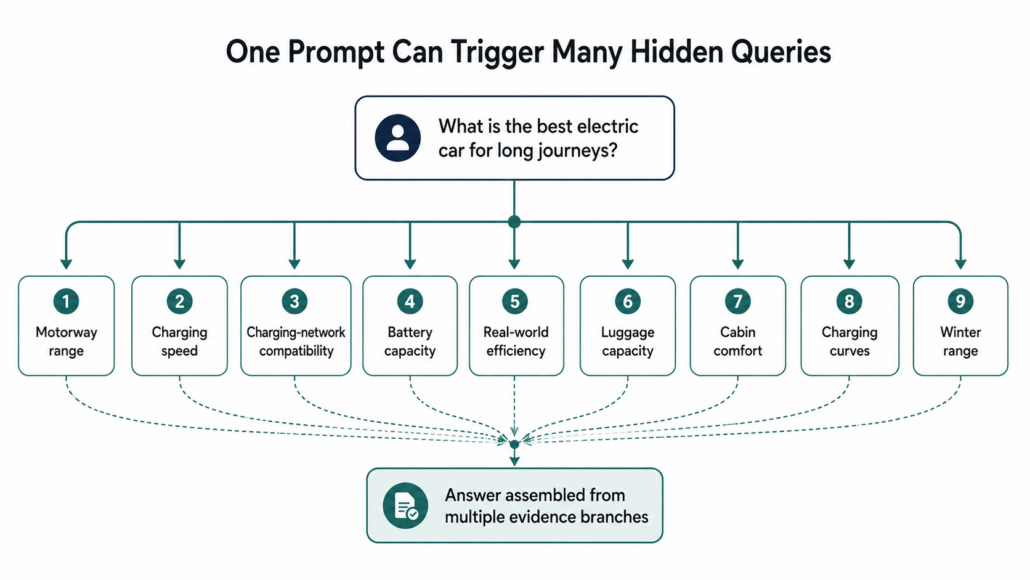
Each one is a possible branch. Some branches may lead to specialist publications. Others may lead to manufacturer specifications, testing organisations, charging-network data or independent reviews. The important point for SEOs is that visibility may depend on whether a site supplies useful information somewhere within that retrieval tree.
Ranking one page for the original wording is no longer the only possible route into the answer. A site might participate because it has the strongest data on winter range. Another may provide the clearest explanation of charging curves. A manufacturer might become the primary source for battery capacity or vehicle dimensions. The final generated answer can potentially combine those pieces.
That is a more distributed model of search visibility than the familiar idea of one query producing one winning page.
Retrieval-Augmented Generation: What Happens Before the Answer
To understand grounding properly, it helps to understand Retrieval-Augmented Generation. Usually shortened to RAG, it describes an architecture in which a language model is given information retrieved from external sources before producing its response. Google describes RAG as combining language models with external knowledge sources to improve generated outputs.
The process is conceptually straightforward.
- Information is first collected and indexed.
- A user then asks a question.
- The retrieval system searches its available information sources and identifies relevant material.
- That material is supplied to the language model as context.
- The model generates an answer using both the user’s request and the retrieved information.
Microsoft describes essentially the same pattern: relevant data or documents are retrieved and injected into the model’s context so that the generated response can make use of them.
For SEO practitioners, one part of this sequence is particularly important:
Retrieval comes before generation.
Before content can influence a grounded answer, several things may need to go right.
The content may need to be:
- discovered
- processed
- understood or represented
- considered relevant to the retrieval request
- selected at passage or document level
- judged useful enough to pass to the model
- actually used when the model constructs the answer
A traditional ranking position may affect that process, particularly where web search is used as a retrieval mechanism, but it is no longer the whole story. Ranking becomes one component within a broader information pipeline. That is one of the most useful mental shifts for GEO.
The question is no longer only “Can this page rank?” It is also “Can this information successfully move through the retrieval pipeline?”
Information Ingestion: The Part That Happens Even Earlier
GEO discussions often begin with prompts. That may already be too late. Before a system can retrieve a piece of information, the information has to become available to that system. Broadly, we can call this information ingestion.
Depending on the platform and retrieval architecture, ingestion may involve processes such as:
- crawling
- fetching
- parsing
- extracting document content
- cleaning text
- identifying page structure
- extracting metadata
- splitting documents into chunks
- generating embeddings
- identifying entities
- creating indexes
- storing relationships and attributes
This is where GEO reconnects very quickly with technical SEO.
Google Search, for example, still relies on automated crawlers to discover pages that may be added to its index. If important content is difficult to access, hidden behind problematic rendering, badly canonicalised, duplicated across many URLs or blocked from discovery, polishing its prose for AI retrieval will not solve the underlying problem.
The first requirement is less glamorous than many GEO discussions suggest:
Make the information technically accessible.
This is one reason it is misleading to talk about GEO as though it replaces SEO.
Many of the foundations are the same. The new retrieval layers sit on top of those foundations. They do not make them disappear.
Documents Are Increasingly Broken Into Information Units
Traditional SEO tends to treat the URL as the main unit of optimisation. Retrieval systems do not necessarily work at that level. A long document can be divided into smaller pieces, usually called chunks.
Imagine a 4,000-word guide containing separate sections about:
- installation
- pricing
- maintenance
- performance
- troubleshooting
If the user asks only about maintenance, there may be little value in retrieving all 4,000 words. The system can instead retrieve the relevant section.
That gives us another useful principle:
The retrievable unit may be a passage rather than a page.
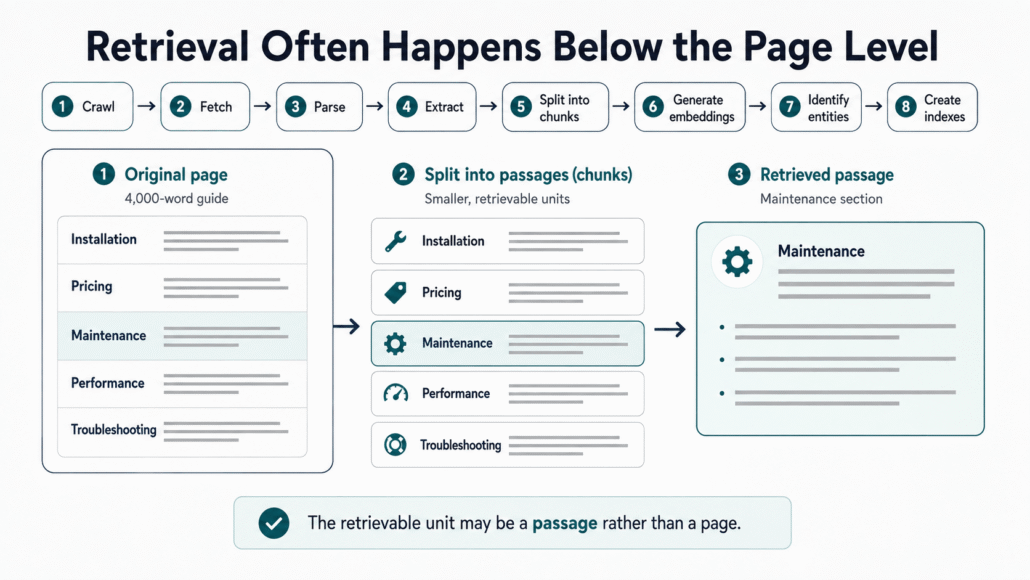
This has practical implications for content writing. Sections should be able to stand on their own reasonably well. Headings should tell readers – and machines – what the section is actually about. Important claims should not rely too heavily on a pronoun or reference located several paragraphs earlier.
Entities and their attributes should be clearly connected.
Compare these two sentences:
“It also performs significantly better under these conditions.”
and:
“Air-source heat pumps generally operate more efficiently at moderate outdoor temperatures than during periods of extreme cold.”
The first sentence makes perfect sense when surrounded by the right context. Remove it from that context, and it becomes nearly useless. What is “it”? What are “these conditions”? What kind of performance is being discussed?
The second sentence carries much more of its meaning with it. That matters if the sentence or paragraph is extracted, embedded, indexed, retrieved or quoted independently. This does not mean every paragraph should sound robotic.
Writing for retrieval is not the same as eliminating style. It simply means recognising that parts of the page may travel without the rest of it.
Semantic Retrieval: Matching Meaning, Not Just Words
Keyword matching works best when the query and document share similar vocabulary. People, however, constantly express the same idea in different ways.
Someone might search:
“How do I make my phone last until bedtime?”
A useful page might be titled:
“How to Improve Smartphone Battery Life”
The wording is different. The meaning is very close.
Semantic retrieval is designed to deal with that difference. Rather than relying exclusively on exact lexical overlap, modern retrieval systems can use semantic ranking, vector search or hybrid methods to find content that is conceptually relevant even where the vocabulary differs.
Microsoft documents RAG architectures involving vector search, semantic ranking and hybrid retrieval. This has obvious implications for keyword strategy. It does not mean keywords have stopped mattering. Precise terminology remains extremely useful, particularly for product names, named entities, technical specifications, specialist concepts and factual lookups where ambiguity needs to be minimised.
But there is now another dimension to consider:
semantic completeness.
A strong page should explain its subject clearly enough that a retrieval system can recognise its relevance even when the user’s wording is different.
That encourages better content. It rewards pages that genuinely cover a subject rather than pages engineered around repeated variants of one keyword.
Embeddings: Turning Meaning Into Something Searchable
Embeddings often sound more complicated than they need to. At a basic level, an embedding is a numerical representation of information. A piece of text – a sentence, paragraph, document or chunk – is converted into a long sequence of numbers known as a vector. Content with similar meaning can then be located relatively close together within that mathematical representation.
Suppose you have these two sentences:
“How can I reduce my electricity bill?”
and:
“Ways to lower household energy costs.”
The language is quite different, but the ideas are closely related. An embedding model may therefore represent them as semantically similar. A retrieval system can create an embedding for the user’s query and compare it with embeddings representing stored content. Passages or documents that are close enough can become retrieval candidates.
Microsoft notes that embedding-model choices can affect the relevance of vector-search results, while Google also documents embeddings in connection with semantic search and RAG workflows.
For SEO practitioners, embeddings provide a technical explanation for something that good content strategists have understood intuitively for years:
Conceptual relevance matters.
You cannot optimise an embedding in the same direct way you might rewrite a title tag. There is no meaningful equivalent of “put the keyword here three times.” What you can do is create content whose meaning is clear.
Useful characteristics include:
- explicit explanations
- clear topical focus
- good coverage
- consistent terminology
- sufficient context
- strong relationships between entities and their attributes
That gives semantic retrieval systems better information to represent and compare.
Hybrid Retrieval: It Is Not Keywords Versus Semantics
Whenever a new search technology becomes popular, there is a temptation to declare the previous one dead.
Semantic retrieval does not make lexical search obsolete.
Many modern retrieval systems deliberately combine methods.
A system might use:
- lexical retrieval to identify documents containing important words or phrases
- vector retrieval to locate conceptually related passages
- semantic ranking to reorder candidates according to contextual relevance
- metadata filtering to restrict results by date, language, category or document type
- reranking to use an additional model to identify which candidates best answer the question
This combination is often described as hybrid retrieval. From an SEO perspective, that is a useful corrective to simplistic claims that keywords no longer matter.
The emerging model is much more likely to be:
keywords + semantics + entities + context + authority + retrieval relevance
Traditional SEO signals still have a role.
They are simply operating alongside additional ways of understanding and selecting information.
Entities: Stable Anchors in AI Retrieval
Entities are one of the strongest connections between traditional SEO and GEO. An entity is a distinct, identifiable thing.
That can include:
- a person
- an organisation
- a location
- a product
- an event
- a concept
- a chemical
- a book
- a technology
Search engines have been moving beyond strings of characters towards entities and relationships for many years. AI retrieval makes this even more important. Entities give information structure.
Consider:
“Mercury has a temperature of around 167°C.”
The sentence looks factual, but “Mercury” is ambiguous. It might refer to the planet, the chemical element, a brand, a person or a figure from mythology.
Now compare:
“Mercury, the closest planet to the Sun, has an average surface temperature of approximately 167°C.”
The second version identifies the entity and connects it to an attribute. That is much easier to interpret.
For retrieval systems, useful relationships can include:
Entity → Category
What type of thing is it?
Entity → Attribute
What properties or characteristics does it have?
Entity → Creator
Who founded, developed, created or produced it?
Entity → Location
Where is it based, found, available or used?
Entity → Specification
What measurable or technical characteristics define it?
Entity → Use case
What is it used for?
Entity → Comparison
How does it differ from another entity?
Entity → Date
When was it launched, founded, updated, published or changed?
Once you think in those terms, a lot of GEO starts looking less like copywriting and more like knowledge architecture. That is probably the right direction.
Relationships Matter More Than Repetition
Older forms of SEO sometimes encouraged an overly mechanical idea of relevance:
If a keyword is important, mention it repeatedly. That is a poor model for semantic retrieval.
Imagine two articles about coffee grinders. The first repeats “best coffee grinder” twenty times.
The second explains:
- burr versus blade mechanisms
- grind-size consistency
- espresso requirements
- filter-coffee requirements
- burr materials
- grind retention
- motor speed
- adjustment mechanisms
- maintenance
The second document gives the retrieval system far more useful information. It connects the entity coffee grinder with the attributes and comparisons that matter to people asking real questions. It provides a richer semantic environment. That leads to a much more useful GEO principle than keyword repetition:
Optimise relationships, not repetition:
- Explain what something is.
- Explain what it does.
- Explain what properties matter.
- Explain how it differs from alternatives.
- Explain where the limitations are.
That information can support a much wider range of retrieval tasks than repeated keyword variants.
Structured Data and Machine-Readable Meaning
Structured data remains relevant in this environment because it gives machines explicit information about entities and attributes. Google explains that structured data provides Search with clues about the meaning of a page and its content. That makes structured data useful. It does not make it a magic GEO switch.
Adding schema markup does not guarantee inclusion in an AI-generated answer.
Its value is better understood as one part of an information-consistency strategy. Ideally, several signals should agree with one another:
- visible page content
- structured data
- titles
- headings
- internal links
- canonical URLs
- author information
- product information
- organisation information
- other authoritative references
If a page says one thing, the structured data says another and other pages use inconsistent names for the same entity, the system has more ambiguity to resolve. Clear and consistent entity representation reduces that ambiguity. That may sound less exciting than “GEO hacks”, but it is much closer to how robust information systems tend to work.
The Grounding Query Gap
Grounded AI also creates a measurement problem.
Traditional SEO gives marketers visibility into a meaningful portion of the search journey:
User query → impression → ranking → click → landing page
AI retrieval introduces a hidden middle layer. The process may look more like:
User prompt → interpretation → hidden subqueries → retrieved sources → selected passages → generated response
The SEO practitioner may be able to see the prompt. They may see the citation in the final answer. They may receive referral traffic from the AI platform. What they usually cannot see is every retrieval operation that happened between those points. That missing information can be thought of as the Grounding Query Gap.
It is the gap between:
what the user asked
and
what the AI system searched, retrieved or evaluated in order to answer.
Google’s public documentation of query fan-out makes this more than a theoretical concern. One user query can trigger several related searches. This is why simply maintaining a list of prompts and repeatedly asking an AI chatbot which brands it recommends gives an incomplete picture of GEO performance.
Prompt tracking can be useful. But the visible prompt may represent only the surface of the retrieval process.
What Grounding Queries Mean for Keyword Research
Keyword research is not disappearing.
It still tells us a great deal about the language people use, the scale of demand and the commercial or informational intent surrounding a topic. But it needs another layer.
Instead of looking only at:
What does the user search?
GEO research should also consider:
What information would a retrieval system need in order to answer that question well?
Consider:
“Is solar power worth it for a small house?”
Traditional keyword research might uncover phrases such as:
- are solar panels worth it
- solar panel cost
- solar panel savings
- solar panels small house
All of those are useful. A grounding-oriented analysis goes further.
It might map the problem through several dimensions.
Entity
Solar photovoltaic system.
Attributes
Installation cost, system size, electricity production, panel efficiency, lifespan and maintenance.
Economic factors
Electricity prices, payback periods, export payments and installation grants.
Environmental factors
Carbon reduction, the local energy mix and manufacturing impact.
Property factors
Roof orientation, available roof area, shading and location.
This is no longer merely a collection of keyword variants. It is a model of the information surrounding the question. That is a much richer foundation for content strategy.
From Topic Clusters to Retrieval Coverage
SEO has talked about topic clusters for years. Grounded AI gives that idea a stronger technical rationale. A well-structured topic architecture can create many potential retrieval entry points around an entity.
Imagine a website covering home insulation. Rather than relying on one enormous generic page, the site might contain well-connected resources about:
- loft insulation
- cavity wall insulation
- solid-wall insulation
- insulation materials
- installation costs
- thermal conductivity
- energy savings
- older properties
- moisture considerations
- professional installation
- DIY installation
Each page contributes information that may satisfy a different retrieval need. Internal linking then helps establish relationships between those resources.
The objective is not to create a separate page for every prompt somebody could theoretically type. That would quickly become unmanageable and would probably produce a large amount of thin or repetitive content. A better goal is retrieval coverage.
Does the site’s information architecture contain useful evidence for the major questions, entities, attributes, comparisons and relationships surrounding the topic?
That is a far more durable strategy than trying to predict every possible conversational query.
Passage-Level Optimisation
Once retrieval systems begin selecting chunks rather than entire documents, passage quality becomes increasingly important. A strong retrievable passage normally does several things well.
- It answers a recognisable question.
- It identifies the main entity clearly.
- It contains enough context to make sense outside the full document.
- It uses accurate terminology.
- It provides meaningful factual detail.
- It avoids unnecessary ambiguity.
Compare:
“Another benefit is that they can last much longer, particularly when properly maintained.”
with:
“Lithium iron phosphate batteries can offer a longer cycle life than many conventional lithium-ion chemistries, particularly when operated within recommended temperature and charging ranges.”
The second passage is much more useful independently. You know exactly what technology is being discussed. You know what property is being compared. You know some of the conditions affecting the claim.
If that paragraph is extracted from the article and retrieved independently, it still carries most of its meaning.
This is the quality GEO practitioners should be thinking about. Not because every paragraph needs to be written like a database entry, but because important information should not collapse when separated from surrounding prose.
Technical SEO Still Sits Underneath GEO
The excitement around generative AI sometimes makes GEO sound like a completely new discipline.
It is not.
Google has explicitly said that the same foundational SEO practices remain relevant to its AI search experiences. It has also stated that publishers do not need special AI-specific markup or a new machine-readable file simply to appear in those features. Technical SEO therefore remains fundamental.
That includes:
- Crawlability: Can search engines and retrieval systems discover and access the content?
- Indexability: Can the page be stored and surfaced within relevant search indexes?
- Canonicalisation: Is the preferred version of duplicate or similar content clear?
- Internal linking: Are pages meaningfully connected, and can context and authority flow through the site?
- Rendering: Can important content actually be processed, particularly where JavaScript is involved?
- Status codes: Do URLs return appropriate HTTP responses such as 200, 301 or 404?
- Duplicate management: Is duplicate and near-duplicate content properly controlled?
- Information architecture: Are topics, categories and pages organised logically?
- Mobile accessibility: Does important content remain usable on mobile devices?
- Page performance: Do pages load and respond reliably?
- Structured-data accuracy: Does the markup match what users can actually see on the page?
- Clear content ownership: Can the system identify who produced the information and which organisation is responsible for it?
AI retrieval does not eliminate any of these requirements. It adds additional stages above them.
One useful way to represent that relationship is:
Technical accessibility → information understanding → retrieval relevance → source selection → generated visibility
If the first step fails, every step above it becomes harder.
GEO Is an Information Architecture Problem
A lot of GEO discussion currently focuses on writing tactics.
- Should paragraphs be shorter?
- Should every article contain an FAQ?
- Should writers use more statistics?
- Should definitions appear immediately below headings?
Those questions can be worthwhile, but they are tactical. The deeper problem is information architecture.
Can the system work out:
- what entity the page is about
- which attributes belong to that entity
- how it connects to neighbouring entities
- what questions the information answers
- whether the information is current
- who produced it
- whether the source has relevant authority
- how the information fits into the broader topic
A crawlable site with clearly structured and well-connected information creates a much stronger retrieval environment than a collection of isolated pages created around disconnected phrases. That does not make good writing unimportant.
Quite the opposite.
Clear writing is one of the ways relationships and meaning become explicit. But GEO is bigger than sentence style. It is about how information is organised, connected, represented and maintained.
Authority Means Something Slightly Different in Grounded AI
Traditional SEO discussions often talk about authority through backlinks and ranking signals. Those remain important, particularly because web search itself can be part of an AI system’s retrieval layer.
Grounded AI introduces another useful way of thinking about authority:
Is this source appropriate evidence for this particular claim?
- A medical organisation may be an especially strong source for medical guidance.
- A government database may be more appropriate for legislation.
- A manufacturer may be the strongest primary source for specifications of its own products.
- A regulator may be the strongest source for compliance requirements.
- An independent testing organisation may be preferable when the question involves measured performance rather than manufacturer claims.
Different retrieval queries can therefore favour different kinds of authority. That suggests a more realistic GEO strategy. Instead of trying to become “the authority” on everything within a broad market, ask:
For which facts are we genuinely a primary or especially credible source?
That question is much more actionable. Few organisations can become the best source for every possible question. Many can become the clearest and most reliable source for information they genuinely own.
Freshness and Grounding
Grounding also increases the practical importance of freshness.
A language model’s pretrained knowledge has a temporal boundary. Retrieval allows the system to supplement that knowledge with newer information. Google has explicitly discussed grounding as a way of connecting generative systems with fresh and factual information. For publishers, this creates an obvious risk around time-sensitive content.
Information that can become stale includes:
- prices
- availability
- specifications
- regulations
- schedules
- executive leadership
- product ranges
- research findings
- financial information
Old information is not merely an editorial problem. It can become a retrieval problem.
If an outdated page is still crawlable, indexable and apparently authoritative, the system may need to decide whether it can trust that information.
Content maintenance therefore belongs inside GEO strategy. Keeping important facts current is part of making a site useful to retrieval systems.
Measuring GEO in a Grounding-Query World
Measurement is still one of the hardest parts of GEO.
There are useful signals available. Prompt tracking can show whether a company or domain appears in a sample of generated answers. Referral analytics can show traffic arriving from AI platforms. Citation tracking can identify which pages appear as visible sources. Search Console and other search-platform reporting can provide information about visibility in generative search surfaces. Google, for example, introduced dedicated reporting for generative AI features in Search in 2026.
None of these metrics fully exposes the hidden retrieval process.
A more mature framework therefore needs several layers.
Technical availability
Are important URLs crawlable and indexable?
Entity coverage
Are the organisation’s important entities and attributes clearly represented?
Topic coverage
Does the site address the major information needs surrounding priority subjects?
Traditional search visibility
Does the site rank for relevant informational and commercial searches that might feed retrieval?
AI citation visibility
Which pages appear as sources in generated answers?
AI mention visibility
How often is the organisation, product or entity represented in generated responses?
Referral behaviour
Which AI systems send traffic, and which pages receive it?
Passage performance
Are particular sections, facts or explanations repeatedly retrieved or cited?
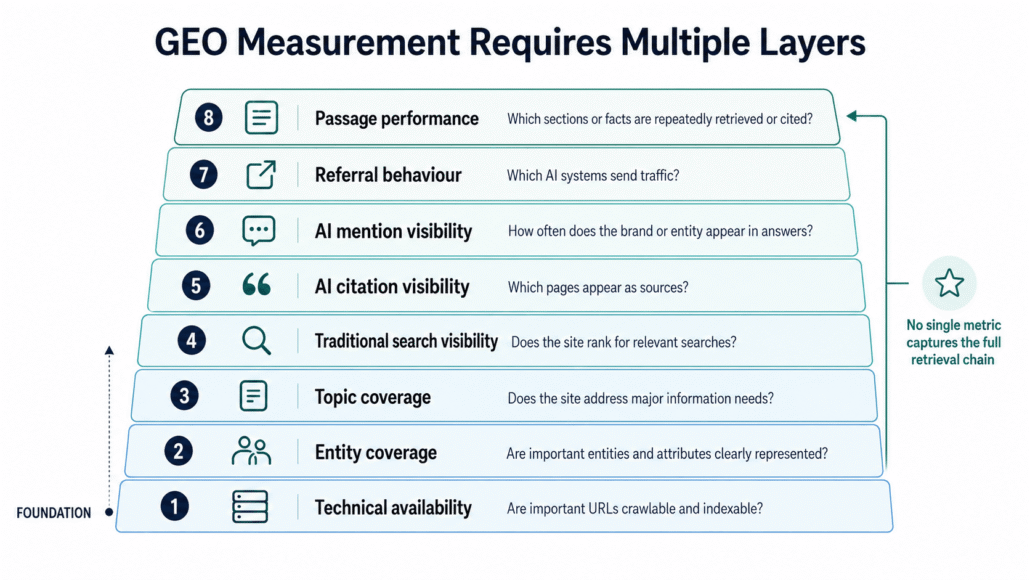
No single metric can summarise all of this. The industry will undoubtedly create various GEO scores, visibility indexes and share-of-answer metrics. Some will be useful.
But the real objective should not be to discover one magical number. It should be to understand where the website participates in the information-retrieval chain and where it drops out.
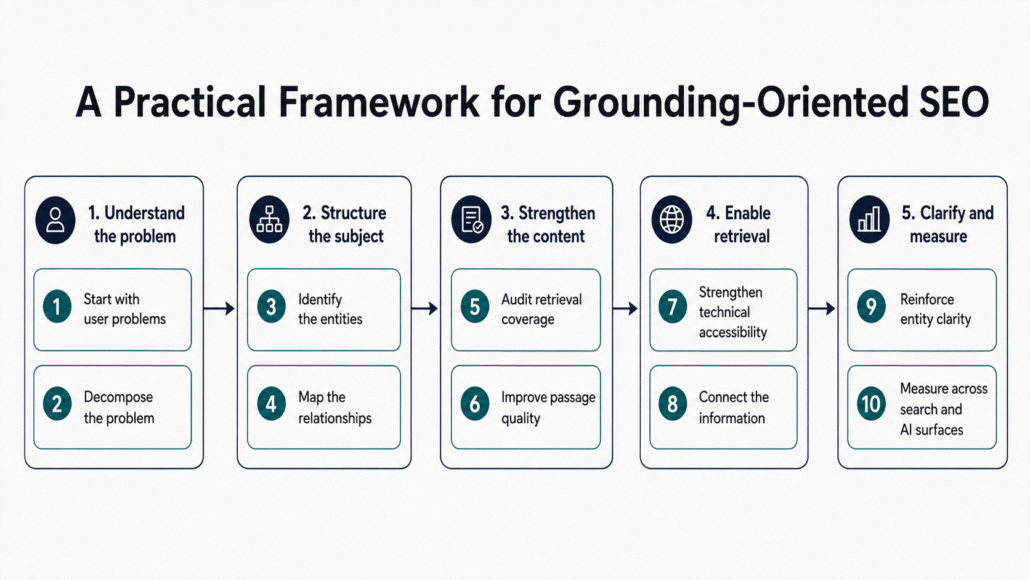
A Practical Grounding-Oriented SEO Framework
For teams trying to adapt existing SEO programmes to this environment, it helps to make the process concrete.
1. Start With User Problems
Do not begin exclusively with keywords.
Start by identifying what users are actually trying to accomplish, understand, compare or decide.
The wording of the query matters, but the underlying problem matters more.
2. Decompose the Problem
Ask what information is needed to produce a genuinely useful answer.
Identify subtopics, attributes, comparisons, requirements, limitations and dependencies.
A complicated question is rarely supported by one fact.
3. Identify the Entities
Map the organisations, products, people, concepts, technologies, locations and categories involved.
Be precise about what each entity actually is.
4. Map the Relationships
Think about how those entities connect.
Useful relationship patterns can include:
Product → Feature
Which specific capability or characteristic belongs to the product?
Technology → Benefit
What outcome or practical advantage does the technology produce?
Service → Eligibility requirement
Who qualifies, and under what circumstances?
Condition → Treatment
What treatment or management option relates to the condition?
Location → Regulation
Which laws, rules or requirements apply in that place?
This kind of mapping often reveals missing content more effectively than keyword lists do.
5. Audit Retrieval Coverage
Look at the relationships you have mapped and ask whether the website contains clear information about them.
Do not assume that because a topic is mentioned somewhere, it is adequately covered.
Could a retrieval system find a useful passage answering the question?
6. Improve Passage Quality
Make important sections factual, understandable and sufficiently self-contained.
Remove ambiguous pronouns where they obscure important entities.
Use precise terminology where precision matters.
Do not bury the answer underneath several paragraphs of scene-setting.
7. Strengthen Technical Accessibility
Check crawling, rendering, canonicalisation, indexing and duplication.
If the information cannot be reliably accessed or processed, the rest of the work has limited value.
8. Connect the Information
Use internal links, navigation, taxonomies and breadcrumbs to make relationships visible.
A strong information architecture should help both users and machines understand how topics fit together.
9. Reinforce Entity Clarity
Use consistent names.
Add structured data where appropriate.
Make contextual relationships explicit in the visible content rather than assuming the system will infer everything correctly.
10. Measure Across Search and AI Surfaces
Do not isolate GEO measurement from existing SEO reporting.
Look at rankings, citations, AI mentions, referrals, passage visibility and generative-search reporting together.
The objective is to understand the full retrieval ecosystem, not to create two separate marketing disciplines that rarely speak to one another.
SEO Is Moving From Page Optimisation Towards Information Optimisation
Perhaps the most significant change is conceptual.
Traditional SEO often begins with:
Which page should rank for this query?
That is still a useful question. But GEO increasingly requires us to think about the information itself.
- Pages still matter because they provide context and a source location.
- URLs matter because they give content a distinct, discoverable and referenceable address.
- Links matter because they connect pages, topics and entities.
- Rankings matter because they can influence which sources are visible to retrieval systems.
But other units matter too.
Information is the material a system can retrieve and use.
Facts provide concrete details capable of supporting an answer.
Entities identify the people, products, organisations, locations and concepts under discussion.
Attributes describe those entities.
Relationships explain how entities and topics connect.
Explanations provide the context needed for more complex questions.
Comparisons help systems distinguish between alternatives.
Evidence supports claims and increases the usefulness of the information being retrieved.
AI retrieval systems can increasingly break documents into pieces, represent their meaning numerically, retrieve those pieces semantically, combine evidence from different sources and generate an answer from the resulting context.
The unit of optimisation is therefore beginning to expand. The page still matters. But so does the retrievable information object inside the page. That distinction is likely to become increasingly important.
Conclusion: The Grounding Layer Is Becoming Part of SEO
Generative AI does not remove search from information discovery. In many cases, it adds more searching.
One user prompt can lead to several subqueries, multiple retrieval operations and evidence gathered from different sources before the final answer appears.
Google’s documented query fan-out behaviour makes that particularly clear. For SEO and GEO practitioners, the visible prompt is therefore only one part of the landscape.
We still need to ask “What did the user ask?” But that is no longer enough on its own.
We also need to think about questions such as:
- What information does the system need in order to answer?
- Which subqueries might lead it to that information?
- Which entities are involved?
- Which attributes and relationships matter?
- Can our content be retrieved semantically?
- Can an important passage make sense outside the rest of the page?
- Is the information technically accessible?
- Is it current?
- Are we a credible source for the particular fact being retrieved?
This is where technical SEO, semantic retrieval, content strategy, information architecture and GEO begin to converge. The future of optimisation is unlikely to depend on discovering a secret collection of tricks designed specifically for language models. That would be a comforting idea because tricks are easy to package, sell and implement.
The reality is more demanding.
Organisations need to make their information easier to discover, easier to understand, easier to retrieve, easier to verify and easier to use.
That means technical accessibility still matters.
- Clear writing still matters.
- Authority still matters.
- Keywords still matter.
- Structure still matters.
- Freshness still matters.
The difference is that all of these elements are increasingly being evaluated within a retrieval process that can operate below the level of the page and beyond the wording of the original query.
Traditional SEO helped search engines find the right page.
The next phase of SEO and GEO is increasingly concerned with helping retrieval systems find the right information, inside the right source, at the right moment.
Understanding grounding queries is one of the clearest ways to understand that transition.